
Generative Media Beyond the Model Race
In two years, the louder conversation will likely be about orchestration, agent frameworks, and taste, while model quality quietly becomes table stakes rather than the headline.

Hey, it’s Samet.
This week I kept circling the same question: if generative media keeps moving this fast, where do we actually land two years from now.
My honest take: models will keep improving, but they won’t stay the main storyline. Let me explain why, and where I could be wrong.
The myth of the “one model to rule them all” is dead
For a while, everyone bet on an “omni model” that would handle image, video, audio, and 3D in one shot. That’s not what happened. Enterprise production stacks now run an average of 14 different models simultaneously, because each model is strong at one narrow thing and weak everywhere else.
In 2025 alone, fal integrated 985 new models and endpoints across video, image, audio, 3D, and speech. So the real product skill isn’t “which model do I pick” anymore, it’s “how do I chain these models into a workflow that actually ships.”
That shift shows up in language across the whole AI industry, not just media. Forrester analyst Charlie Dai points out that as foundational models commoditize quickly, attention moves to agent frameworks built for autonomy, usability, and control.
Chris Messina puts it even more sharply: as production costs approach zero, the savviest people shift from execution to articulation and orchestration, combining taste and judgment to cut through the noise.
So are models really becoming secondary? Here’s my honest confidence check
I’m fairly confident models will keep grabbing headlines and investment dollars, because Gartner still projects generative AI model spending to grow 117% this year alone, with domain specific models growing 210%. That’s not a market treating models as an afterthought.
So no, I’m not fully sure models stop being a main topic. It’s more accurate to say models split into two tracks: the underlying engine, which quietly commoditizes, and the applied layer, which is where the visible competition moves.
There’s real disagreement here too. Nvidia’s Jensen Huang and analysts covering the OpenClaw moment argue foundation models are becoming commodities, with attention shifting to the agent frameworks and harnesses built on top.
But investors like Greylock Partners‘s Jerry Chen push back, arguing that underlying foundational models remain more capable than open-weight alternatives and still matter enormously. One widely repeated framing from that debate: “marry the harness, date the model,” meaning teams commit to their tooling while staying flexible about which model powers it.
What this means for product teams
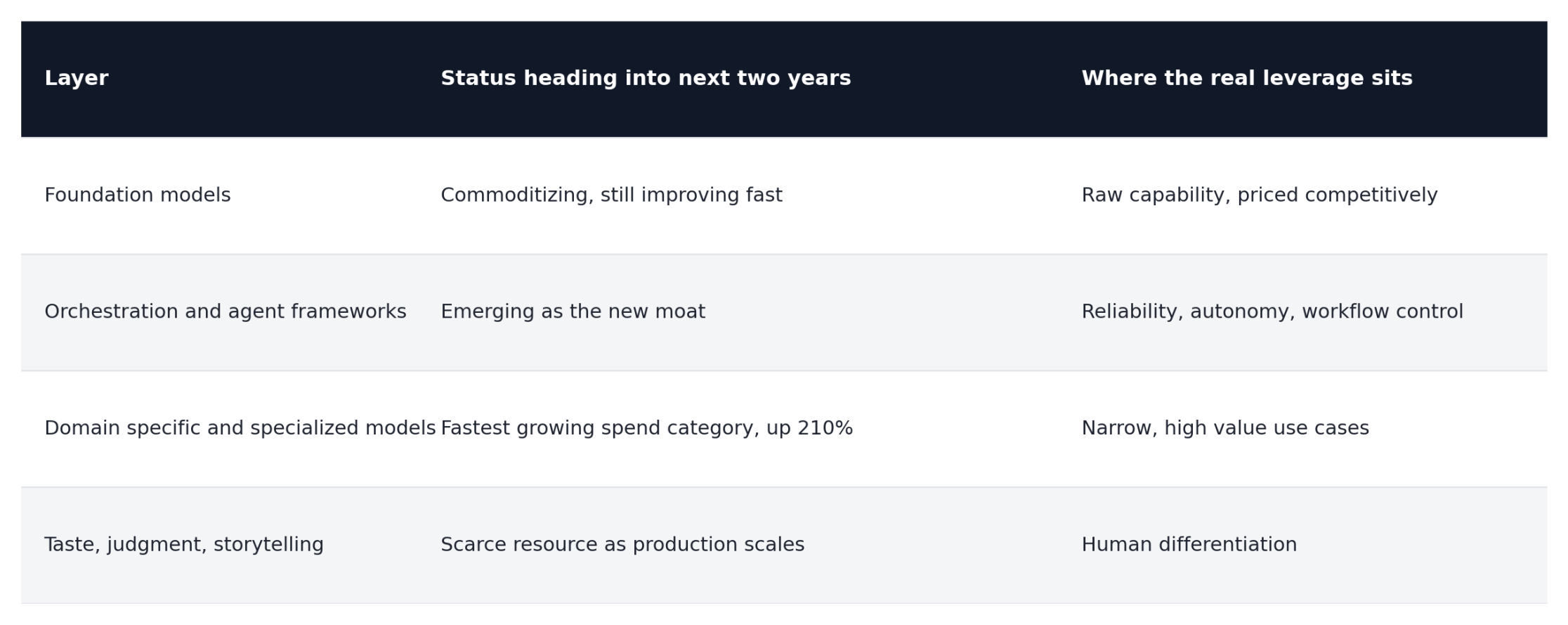
Models remain a major topic, but not the only one, and perhaps not the loudest one. In two years, the louder conversation will likely be about orchestration, agent frameworks, and taste, while model quality quietly becomes table stakes rather than the headline.
Until next issue, keep experimenting.
Samet Özkale, AI for Product Power